

The Problem Isn't the Trousers — It's the Proportions
Most people who buy wide-leg or straight-cut trousers and never quite feel right in them didn't buy the wrong pair. They just paired them with the wrong top, the wrong shoe, or the wrong tuck — and the whole thing landed somewhere between "trying" and "gave up." The silhouette is actually very forgiving once you understand what it's doing, and what it needs from the rest of the outfit to work.
Wide-leg and straight-leg trousers both create volume below the waist. That's not a flaw — it's the point. The job of everything above and below the trouser is to either balance that volume or deliberately contrast it. When that relationship is off, the outfit looks accidental. When it's right, it looks considered.
Know Which Cut You're Working With
These two silhouettes get lumped together, but they behave differently on the body.
Straight-leg trousers have a consistent width from hip to hem — not wide, not tapered. They're the more versatile of the two: they read as relaxed without being casual, and they sit in a sweet spot that works across most body types and occasions. Think of them as the trouser equivalent of a well-fitted crewneck — reliable, unfussy, works with almost everything.
Wide-leg trousers have a more dramatic flare from the thigh down. They make a stronger visual statement and require a bit more intention in styling because the volume is harder to ignore. Get the balance right, and they look genuinely elegant. Get it wrong, and the trouser wears you instead of the other way around.
The Torso-Length Rule Nobody Talks About
The single most overlooked variable in styling wide or straight trousers is your torso length relative to your legs — and most guides skip it entirely in favor of generic "tuck in your shirt" advice.
If you have a longer torso, a full tuck or a half-tuck that shows the waistband will visually shorten your torso and lengthen your legs — which is exactly what you want with a wide-leg trouser. An untucked top that hits at the hip will merge your torso and trouser into one long block, which kills the silhouette.
If you have a shorter torso, a full tuck can feel like it shortens you further. A cropped top — one that ends just at or slightly above the waistband — actually creates the illusion of longer legs without making your torso disappear. You get the same elongating effect, just through a different route.
The principle in both cases is the same: you want a clear visual break at the waist. That break is what makes the trouser look like a deliberate choice rather than an afterthought.
What to Wear on Top
Volume at the bottom calls for something more fitted on top — but "fitted" doesn't have to mean tight. It means structured enough to define your upper half against the trouser's width.
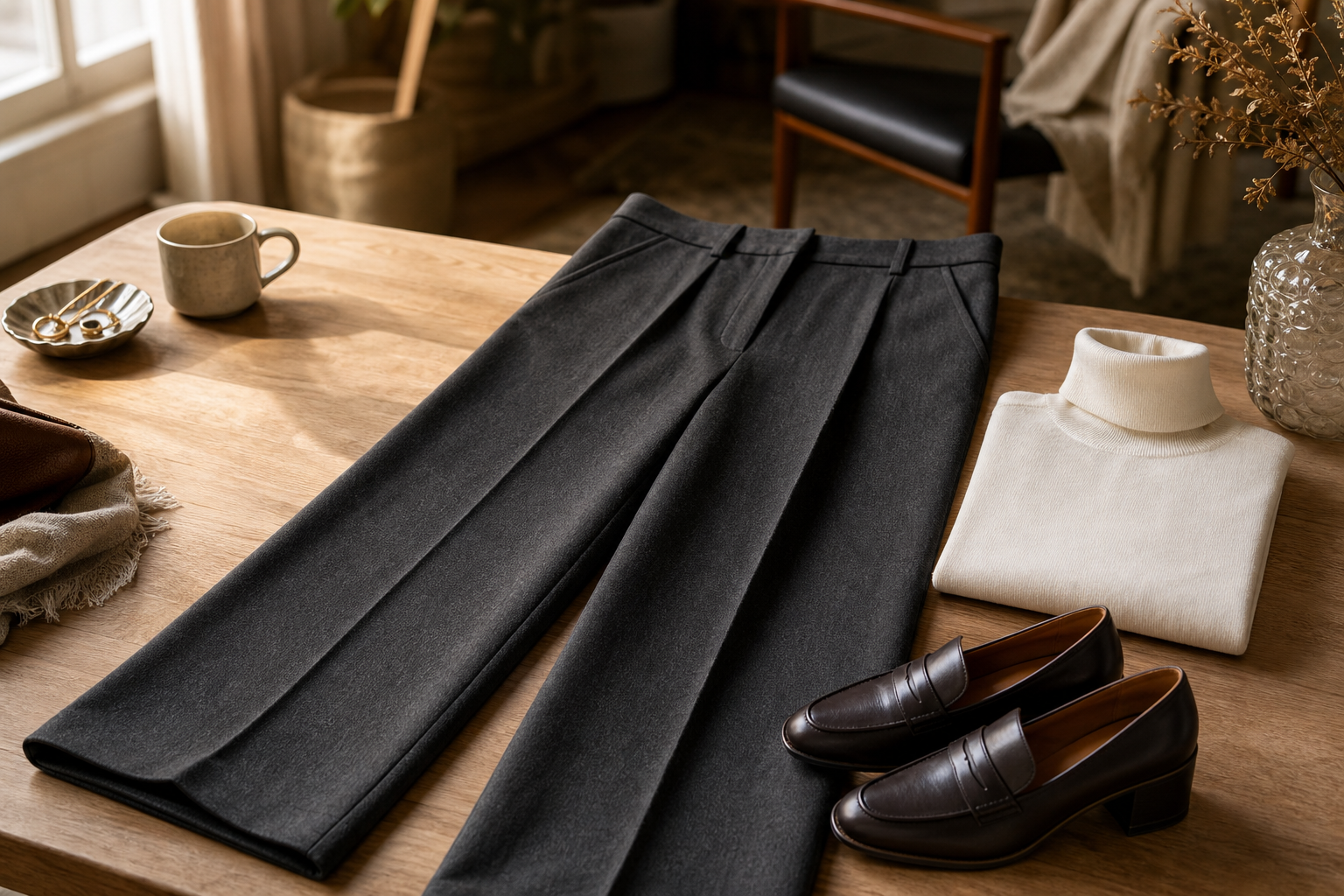
- A roll neck or fitted crewneck works beautifully with wide-leg trousers. The clean neckline and close fit on the torso create a contrast that makes the trouser look intentional rather than oversized. A slim roll neck in particular — like a short-sleeve version for warmer months — brings a European edge to the pairing.
- A tailored shirt, half-tucked, is one of the easiest ways to dress up a straight-leg trouser without trying too hard. The half-tuck signals that you thought about it, which is exactly the vibe.
- A cropped jacket or blazer is the highest-leverage piece you can add. It defines the waist, adds structure, and instantly moves the outfit toward office-appropriate without changing the trouser at all.
- Oversized tops are the exception, not the rule. An oversized tee or sweater can work with a straight-leg trouser if the hem hits at hip level and you're going for a deliberately casual look — but with wide-leg trousers, it almost always reads as shapeless. When in doubt, go more fitted on top.
Shoes Change Everything
This is the part of trouser styling that makes or breaks the look, and it's where most people underestimate what's at stake.
For wide-leg trousers: you need a shoe with some visual weight at the hem. A chunky sole, a block heel, a structured loafer — something that grounds the trouser and stops the hem from looking like it's swallowing your foot. Thin-soled sneakers or delicate sandals tend to disappear under wide-leg hems, which makes the whole outfit look unfinished. A pointed-toe flat or a low block heel are the sweet spot for a dressed-down day; a structured Oxford or loafer works for the office.
For straight-leg trousers: you have more freedom. A clean white sneaker keeps things relaxed. A leather loafer or a simple Chelsea boot moves it toward smart-casual. The hem length matters here — straight-leg trousers that break slightly at the ankle look best with shoes that have a defined silhouette (not a thick-soled trainer that interrupts the line).
One more thing: if you're wearing wide-leg trousers with heels, the heel should be visible below the hem. A hem that fully covers the heel looks like the trousers are too long, not intentionally dramatic.
From Saturday to the Office: The Two-Decision Shift
The same trouser really can work across both contexts — but only if you understand which two decisions are doing the heavy lifting.
Decision 1: The top. A graphic tee or a soft knit reads weekend. A structured shirt, a tailored knit, or a fitted blazer reads office. The trouser doesn't change; the top changes the register entirely.
Decision 2: The shoe. A clean sneaker or a casual loafer keeps it relaxed. A leather shoe, a pointed flat, or a low heel moves it into professional territory. These two levers — top and shoe — are genuinely all you need to shift context.
If you're building a wardrobe around versatile pieces, a well-cut straight-leg trouser in a neutral (charcoal, navy, camel, or a clean off-white) is one of the highest-return investments you can make. It's the piece that makes the rest of your wardrobe work harder. You can read more about building that kind of intentional foundation in our guide to building the perfect business casual wardrobe.
The Colour and Fabric Factor
Fit and proportion are the foundation, but colour and fabric finish the job.
Wide-leg trousers in structured fabrics — a crisp cotton, a woven poly-blend, a light wool — hold their shape and look deliberate. Drapey fabrics like satin or crepe can work beautifully in wide-leg cuts but require more care: they need a very clean top and a confident shoe, or they slide into looking unintentional fast.
For colour: neutrals are the most versatile starting point, but don't be afraid of a wide-leg trouser in a bold colour or a subtle pattern. A wide-leg trouser in a warm terracotta or a deep plum with a simple white or cream top on top is a complete outfit with very little effort. The volume of the trouser does the talking; the top just needs to stay out of the way.
If you're experimenting with pattern, keep it on the trouser and keep the top solid. A wide-leg trouser in a subtle check or stripe with a fitted solid-colour top is a combination that looks considered without being overdressed.
Common Mistakes Worth Avoiding
Hemming them too short. Wide-leg and straight-leg trousers both need length to work. A hem that hits mid-calf on a wide-leg trouser looks like a cropped style that wasn't meant to be — and not in a good way. Aim for a hem that grazes the top of your foot or breaks slightly at the ankle.
Wearing them with a belt you can't see. If you're tucking in your top and wearing a belt, make sure it's visible. A belt that disappears under a loose top is a wasted detail. If the belt is going to be hidden, skip it and use the waistband alone to define the break.
Matching the volume on both ends. A wide-leg trouser with an oversized puffer jacket is a lot of volume in two directions. It can work in very specific styling contexts, but as a default, it's a difficult balance to pull off. When the trouser is wide, keep the outerwear lean — a fitted coat, a tailored jacket, a structured denim jacket.
And if you're building out the accessories to complete these looks, it's worth being deliberate about what you add — our accessories audit guide is a good place to check what's actually missing before you buy anything new.
Find trousers worth styling at Wardrobe Crush — shop the men's and women's bottoms collection and build from there.
Frequently Asked Questions
Can wide-leg trousers work if you're petite?
Yes — but the hem length and shoe choice matter more than usual. Petite frames do best with a hem that just grazes the top of the foot (nothing shorter) and a shoe with a heel or a defined sole to add height at the base. A cropped or tucked-in top keeps the waist visible and avoids swamping the frame. The key is creating a clear waist-to-leg line rather than letting the trouser take over the whole silhouette.
What's the difference between wide-leg and palazzo trousers?
Palazzo trousers are a subset of wide-leg trousers — they're typically cut from lighter, drapier fabrics and have an even more dramatic flare, often flowing from the hip all the way to the floor. Wide-leg trousers is a broader category that includes more structured, tailored versions. If a trouser is made from a crisp woven fabric and holds its shape, it's wide-leg. If it flows and moves like a skirt, it's probably a palazzo.
Do straight-leg trousers suit all body types?
Straight-leg trousers are genuinely one of the most universally flattering cuts because they don't add or subtract volume dramatically — they create a clean, consistent line. They work well on most body types, though the rise (how high they sit at the waist) and the hem length will have the biggest impact on how they look on any individual frame. A mid-to-high rise with a hem that breaks at the ankle is the most reliably flattering starting point.
Can men wear wide-leg trousers, and how should they style them?
Absolutely. Wide-leg trousers for men have been a strong presence in contemporary menswear for a few years now. The same rules apply: keep the top fitted or at least structured, choose a shoe with visual weight at the hem (a chunky loafer, a leather boot, a clean sneaker with a defined sole), and make sure there's a clear waist break. A fitted roll neck or a tucked-in shirt with a wide-leg trouser is a sharp, modern combination that works from casual to smart-casual.