

The one detail that gives it away every time
You've seen both versions. The first: a person in a roomy tee and straight-leg trousers who looks like they got dressed on purpose, like the proportions are just theirs. The second: someone in roughly the same pieces who looks like they grabbed the wrong bag at a hotel laundry. The clothes are almost identical. The outcome is completely different.
The difference isn't confidence, and it isn't a particular brand. It's a handful of specific decisions — mostly structural — that most style guides gloss over in favor of vague advice like "balance your proportions" or "add a belt." This post is the version that actually explains the mechanics.
Start here: the shoulder seam is non-negotiable
Everything else in oversized dressing is adjustable. The shoulder isn't.
When a shoulder seam drops more than an inch or so past your actual shoulder joint, the sleeve hangs wrong, the chest bunches, and the whole garment reads as too big rather than intentionally roomy. This is the single measurement that separates a deliberately relaxed fit from a size mistake — and no amount of tucking, rolling, or accessorizing fixes it.
So before anything else: check the shoulder. A piece can be as voluminous as you like through the body and the sleeve, but that seam needs to land close to where your shoulder actually ends. If it doesn't, size down and let the rest of the fit be loose, or move on.
The proportion equation: one volume, one structure
The rule that actually works — and that most people intuitively follow when they get it right — is simple: one oversized piece at a time, paired with something that has a cleaner line.
An oversized top wants a slimmer or more tapered bottom. Straight-leg or slim trousers, fitted jeans, a midi skirt with a defined silhouette. The bottom doesn't need to be tight; it just needs to have a shape. Conversely, if you're wearing wide-leg trousers or a roomy skirt, the top should be more fitted — a rib knit, a tucked shirt, a snug tee.
The trap most people fall into is volume on volume: a boxy top with wide-leg pants and a roomy jacket. Each piece individually might be great. Together, they read as shapeless. You don't have to show your body — you just have to give the eye something to follow.
If you want to explore how wide-leg and straight-leg trousers actually work as that grounding bottom piece, this guide breaks down the styling mechanics in detail.
The tuck: partial, full, or none
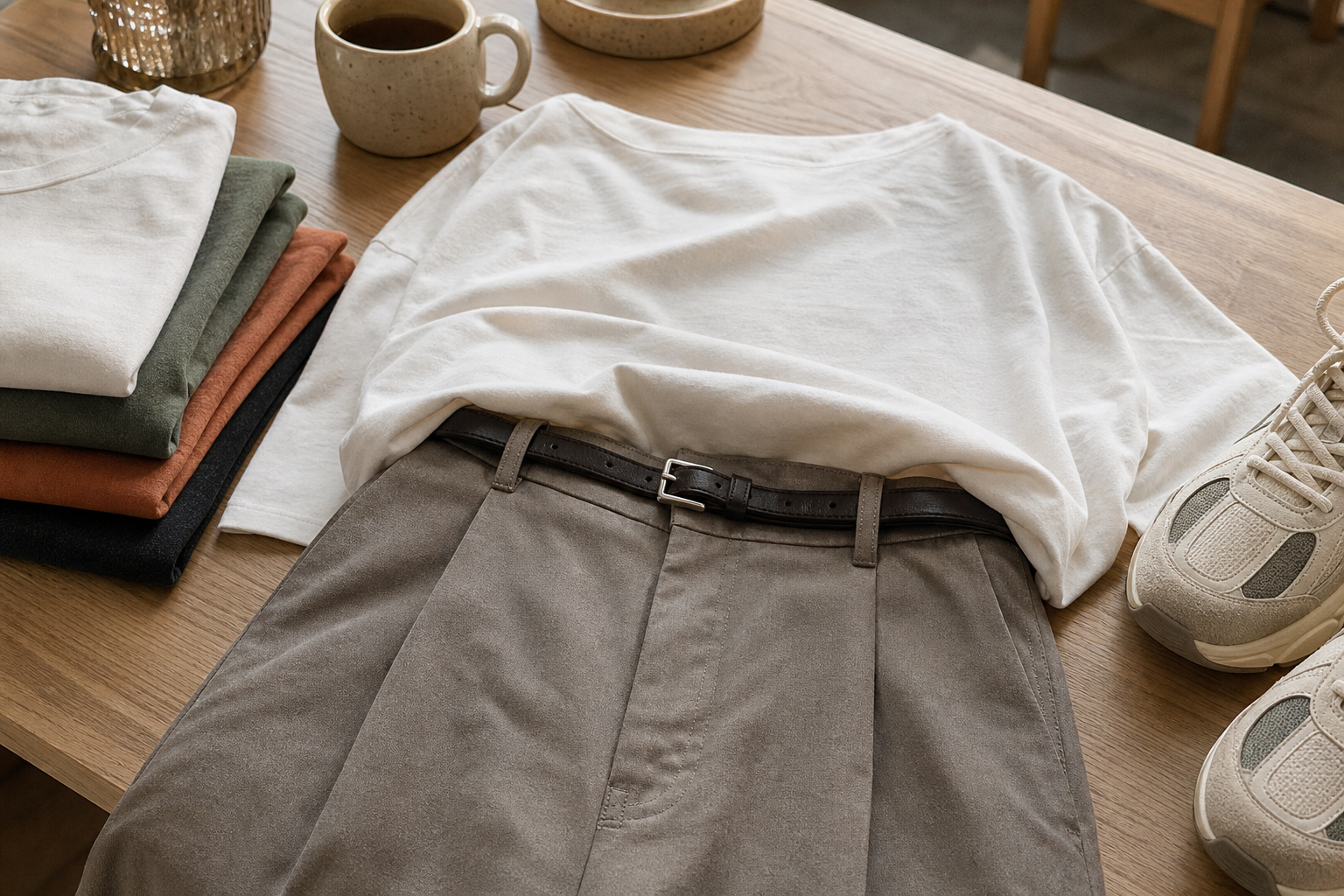
The French tuck — tucking just the front of a shirt or tee into your waistband — exists for a reason. It creates a waist reference without sacrificing the relaxed feel of the top. It's especially useful when you're wearing an oversized piece with high-waisted bottoms and don't want the whole look to sit at your hips.
A full tuck reads more polished and works well when the oversized piece is actually quite long — long enough that leaving it untucked would completely obscure the bottom half. A no-tuck works when the top has a clean hem and hits at a flattering point (usually hip to mid-thigh), and when the bottom has enough visual presence to hold its own.
What doesn't work: a full untuck on an oversized tee that hits mid-thigh over slim trousers. That's not a look — that's a tunic situation, and it needs either a belt, a tuck, or a different bottom entirely.
How footwear shifts the entire read
This is the part most guides skip, and it matters more than almost anything else.
Chunky footwear — a thick-soled sneaker, a platform sandal, a lug-sole boot — grounds an oversized look and makes the volume feel deliberate. It adds visual weight at the bottom, which balances the mass at the top. This is why the oversized-hoodie-with-chunky-sneakers combination has been so durable: the proportions actually make sense.
Delicate footwear — a thin-strapped sandal, a sleek ballet flat, a minimalist pointed-toe shoe — does the opposite. It makes the top half feel even bigger by contrast, which can work beautifully with a more controlled oversized piece (a slightly roomy blazer, a relaxed linen shirt) but quickly tips into overwhelming with genuinely boxy tops or dresses.
Neither is wrong. But you need to know which direction you're going before you get dressed, because the shoes are doing real structural work in this outfit.
Body type isn't the frame — proportion is
The advice that oversized dressing "only works" for tall people or certain body types is worth pushing back on. What's actually true is that different bodies need to think about proportion slightly differently — but the underlying logic is the same for everyone.
If you're petite, the main risk is that volume overwhelms your frame entirely. The fix isn't to avoid oversized pieces — it's to be more precise about where the volume lives. A cropped oversized top (hitting at or just above the hip) with a straight-leg trouser works beautifully. A midi-length oversized tee generally doesn't, because it shortens the leg line and loses the waist entirely.
If you're taller, you have more room to play with length, but the shoulder rule still applies — a piece that's oversized because it's made for a different body shape will still look off, even if the hem lands in the right place.
The question to ask isn't "does oversized work for my body?" It's "where does this piece sit, and does the proportion I've created give the eye a clear path through the outfit?"
The layering shortcut that actually works
Layering is often suggested as a way to make oversized dressing look more intentional — and it can, but only when the layers have different weights or lengths, not when you're just adding more volume to volume.
An oversized tee under an open overshirt works because the overshirt creates vertical lines that break up the mass. A fitted rib vest over an oversized long-sleeve works because you're adding definition on top of volume. A boxy jacket over a boxy tee over wide trousers does not work, because there's nothing to interrupt the shapelessness.
One useful test: if you removed one layer, would the outfit still make sense? If yes, the layer is adding something. If the whole thing falls apart without it, it's probably compensating for a proportion problem rather than solving it.
A note on fabric
Oversized pieces in structured fabrics — a medium-weight cotton, a crisp linen, a woven fabric with some body — hold their shape and drape in a way that reads as intentional. Oversized pieces in very thin, floppy fabric tend to cling in unexpected places and bunch where you don't want them to.
This is why the same cut in two different fabrics can look completely different on the body. If you've tried an oversized style and felt like it didn't work for you, it's worth asking whether the fabric was doing its job — or whether a slightly more structured version of the same silhouette would change the result entirely.
Wardrobecrush's T-Shirts and Polos are a good place to start — pieces cut with enough shape through the body that wearing them loose still gives you a silhouette rather than a shapeless drape. Browse the full casual range at Wardrobecrush and look for pieces where the shoulder seam is doing its job from the start.
Frequently Asked Questions
How do I know if an oversized piece is intentionally cut that way or just too big?
The clearest indicator is the shoulder seam. A piece designed to be oversized will typically still have the shoulder seam landing close to your actual shoulder joint — the extra volume is built into the body and sleeves, not the shoulder construction. If the seam is drooping several inches down your arm, the piece is too large for you, not intentionally relaxed.
Can you wear oversized pieces to work or in more formal settings?
Yes, with the right pairing. An oversized blazer in a structured fabric over a fitted shirt and tailored trousers reads as fashion-forward rather than sloppy. The key is keeping the rest of the outfit clean and precise — the more relaxed one element is, the sharper the others need to be. A roomy linen shirt tucked into well-fitted trousers with clean footwear works in most business casual environments.
If you're building out a work wardrobe with these principles in mind, this guide on business casual dressing covers the balance in more detail.
Is the French tuck actually necessary, or is it just a trend?
It's a technique, not a trend — and it solves a real problem. When you're wearing a relaxed top over high-waisted bottoms, a full untuck hides the waistband and flattens the silhouette. A partial tuck at the front restores a waist reference without making the outfit look overly polished. Whether you use it depends on the specific top and bottom combination, but it's worth trying before deciding the look doesn't work.
Do oversized outfits work for petite frames?
They do, but length is the main thing to watch. Cropped or hip-length oversized tops generally work well for petite frames because they don't interrupt the leg line. Longer oversized pieces — anything hitting mid-thigh or below — tend to shorten the silhouette and can overwhelm a smaller frame unless the bottom half is very streamlined. Pairing with a slightly higher-rise bottom and keeping footwear visible (rather than hidden under a long hem) also helps maintain proportion.