

The promise of AI fashion advice sounds genuinely useful: describe what you own, get outfit ideas back in seconds, no scrolling through Pinterest for forty minutes. So when a pair of deep maroon, Ikat-woven cropped trousers landed on the desk — the kind of piece that sits right at the intersection of traditional craft and modern wardrobe — it felt like the perfect test case. Not a plain black trouser. Not a denim straight-leg. Something with texture, heritage, and a silhouette that asks a few questions before it answers them.
Here's what happened when we ran those trousers through a free AI styling tool, compared the output to what a human eye actually catches, and figured out where the gap between the two actually matters for how you get dressed.
What We Put In
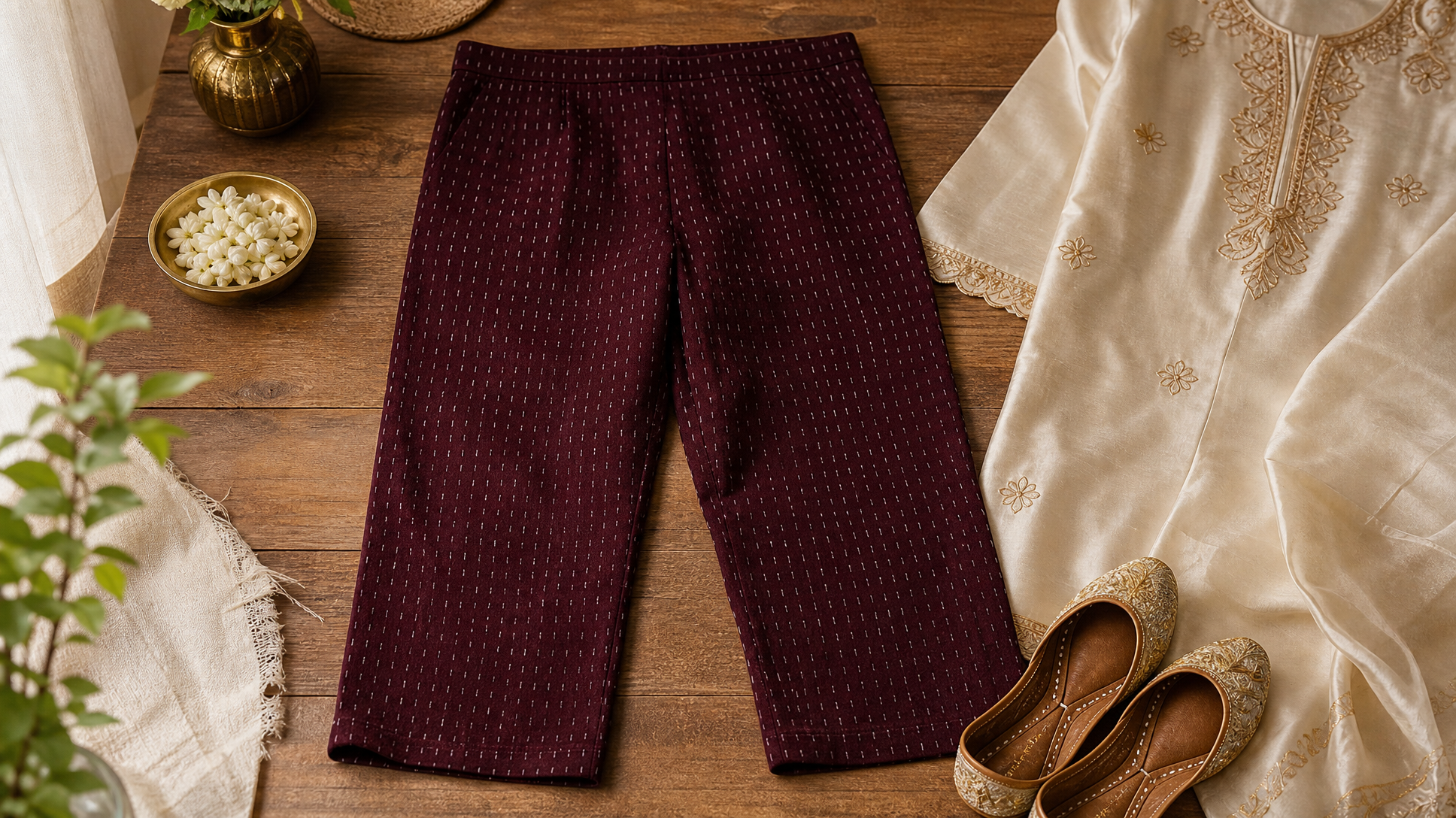
The trousers in question: the Fabindia Women's Relaxed Casual Pants, available at Wardrobecrush. Deep maroon cotton with an allover Ikat weave — small, rhythmic dash-and-dot patterning created through a traditional resist-dyeing and weaving technique. Tapered fit, ankle-length hem, flat front, half-elasticated banded waist, side pockets. The kind of piece that reads as casual from three feet away and genuinely interesting up close.
The prompt to the AI tool was kept simple and honest: maroon cropped trousers with a woven dash pattern, relaxed tapered fit, ankle length. What should I wear with them?
Where the AI Actually Got It Right
Credit where it's due — the basic colour logic was solid. The tool suggested off-white or cream tops, which is genuinely good advice. Maroon is a rich, saturated colour, and pairing it with something neutral at the top keeps the trousers as the focal point without the whole outfit tipping into heavy. The photo of these trousers styled with a white textured button-down shirt proves the point — it works.
It also correctly flagged block-heeled mules or strappy sandals as appropriate footwear for an ankle-length cropped silhouette, which is accurate. Cropped trousers create a natural visual break at the ankle, and a low heel or a clean flat sandal extends the leg line without fighting the hem. (If you want to go deeper on footwear logic for this kind of trouser, the cut-by-cut guide to shoes and dress pants covers the underlying principles well.)
Tucking in a fitted shirt? Also flagged correctly. The half-elasticated waist on these trousers is forgiving enough that a partial tuck — front tuck only, leaving the back loose — gives you a relaxed, intentional silhouette rather than a stiff one.
Where It Missed — and Why It Matters
Here's where it got interesting. The AI had no framework for the Ikat weave itself.
Ikat is a resist-dyeing technique applied to yarn before weaving, which creates the characteristic slightly blurred, feathered edge on each motif — it's not a printed pattern, it's woven into the structure of the fabric. That distinction changes how you style the piece. A printed pattern can compete with other prints or bold graphics at the top. An Ikat weave has visual texture and movement that's more subtle, more layered — it doesn't need help. The AI's suggestion of a graphic tee as a casual option would have turned a considered, artisan piece into visual noise.
The waist detail was another blind spot. The half-elasticated banded waist means these trousers sit comfortably and move well, but it also means the waistband has some structure to it — it's not a simple drawstring. The AI suggested tucking in a chunky knit, which would have added bulk right at the point where the waistband already has presence. A lighter-weight top — linen, cotton voile, a fine-knit — sits better here.
The bigger miss was the complete absence of any ethnic styling direction. These trousers are genuinely versatile across Western and Indian wear — pair them with a kurta or a tunic and the Ikat weave becomes part of a cohesive traditional look rather than a decorative accent on a Western outfit. The AI didn't register that possibility at all. It styled the trousers as if they were any cropped tapered pant, rather than a piece with a specific cultural and craft context that opens up a whole additional wardrobe lane.
What a Human Eye Catches First
The Ikat pattern on these trousers has a natural directionality — the small dashes read as vertical, which already does some lengthening work on the leg. A human stylist notices that and avoids horizontal stripes at the top, which would fight that vertical rhythm. The AI didn't flag this at all.
The maroon itself is a colour with significant seasonal and occasion range. It reads warm and rich in autumn and winter contexts, but the cotton fabric and cropped hem keep it genuinely wearable in transitional weather. That context — fabric weight relative to colour temperature — is something an algorithm flattens into a generic colour-matching exercise.
And then there's the occasion flexibility that a piece like this actually has. Styled with a white linen shirt and block mules, it's a polished daytime look for the office or a lunch out. Styled with a silk kurta and juttis, it works for a traditional gathering or a festive occasion. The AI gave one lane. The trousers have at least three. For more on navigating that range with ethnic pieces, the ethnic wear buying guide breaks down how to choose and style for different occasions without overthinking it.
The Actual Outfit Directions That Work
For a polished everyday look: Off-white or ivory cotton button-down (tucked at the front), tan or nude block-heeled mules, minimal gold jewellery. Let the Ikat pattern carry the visual interest — keep everything else clean.
For the office: A fitted fine-knit top in camel or warm beige, tucked in. Pointed-toe flats or low kitten heels. A structured tote. The maroon reads professional without trying; the Ikat keeps it from being dull.
For a traditional or festive occasion: A printed or solid kurta in ivory, gold, or a complementary deep tone — forest green or rust both work well with maroon. Add kolhapuris or embroidered juttis. The Ikat weave bridges the traditional and the contemporary without any extra effort on your part.
For a relaxed weekend: A loose linen shirt in white or pale yellow, half-tucked. Flat leather sandals. This is the low-effort version that still looks like you thought about it.
The Honest Verdict on AI Style Advice
For basic Western outfit building — neutral trousers, a classic shirt, standard footwear — free AI tools are genuinely useful as a starting point. They've absorbed enough mainstream fashion content to get the fundamentals right.
But the moment a piece has craft context, textile specificity, or cultural range, the algorithm hits a wall. It can't feel the weight of a cotton Ikat weave. It doesn't know that the half-elasticated waist changes what you tuck in. It has no instinct for the fact that these trousers are as at home with a kurta as they are with a linen shirt.
That's not a knock on the technology — it's just an honest account of where it is right now. Artisan pieces deserve more than a generic colour-matching exercise. They reward the kind of attention that actually looks at what the fabric is doing.
Ready to style them yourself? Browse the Fabindia Ikat Trousers and the full collection at Wardrobecrush — and skip the algorithm.
Frequently Asked Questions
What is Ikat weave and why does it change how you style a trouser?
Ikat is a traditional textile technique where yarn is resist-dyed before weaving, creating patterns with a characteristic soft, slightly blurred edge. Because the pattern is woven into the fabric rather than printed on top, it has a depth and texture that a flat print doesn't. That means it can hold its own visually without competing tops — simpler, cleaner pairings tend to work better than bold graphics or busy prints.
Can these maroon Ikat trousers be worn to the office?
Yes — the deep maroon colour and structured flat-front silhouette read polished without being formal. Pair them with a fitted fine-knit or a tucked linen shirt, add pointed-toe flats or low heels, and they work well for most office environments. The Ikat pattern adds quiet visual interest without tipping into casual.
How do you style Ikat trousers for a traditional or ethnic occasion?
These trousers pair naturally with kurtas or tunics — the Ikat weave gives them an inherently traditional aesthetic that bridges Indian and contemporary styling. A solid or subtly printed kurta in ivory, gold, rust, or forest green works well with maroon. Finish with embroidered juttis or kolhapuris rather than Western footwear to lean fully into the traditional look.
What tops work best with a half-elasticated waist trouser?
Because the waistband already has some structure and presence, lighter-weight tops sit better than bulky or heavy knits. Linen shirts, cotton voile tops, fine-knit fitted tops, and lightweight button-downs all work well. A front tuck — tucking just the front of the shirt while leaving the back loose — gives a relaxed but intentional silhouette that flatters this waist style.